Tuesday, August 31, 2010

NY State Math A Regents Exams – The Soft Bigotry (and Political Payoff) of Lowered Expectations

I taught high school Math at NYC Lab School in the mid- to late-1990s, during the days of Sequential Math I, II, and III – before the advent of the soon-to-disappear Math A and Math B. Having spent time in the last 2 –3 weeks helping my 10th grade son prepare for his January Math A exam, I was appalled by the degree to which expectations for high school mathematics competency in New York State (and consequently NYC) has been diminished. The phenomenon President Bush often cites about “the soft bigotry of low expectations” has indeed become a real! ity in New York State.

The Math A exam consists of 30 multiple choice questions, each worth two points, plus nine extended answer questions variously worth 2, 3, or 4 points. The maximum possible score is 84, but conversion to a 100-point scale is done by a test-specific conversion chart rather than a strict percentage basis. On the June 2007 exam, for example, a student needed to earn only 35 of those 84 points (41.7%) to earn a passing grade of 65. On today’s January 2008 exam, the cutoff dropped again, to 34 out of 84. In other words, 40.5% is now the new 65%.

But wait, it gets worse. Suppose a student knew the answers today to 13 of the 30 multiple choice questions and blindly guesses at the other 17 (assume for the moment that he or she cannot answer any of! the extended answer questions). This student has a 1/4 chance! of gues sing correctly on each of those 17 remaining multiple choice questions, so on average he or she can get 4.25 more questions correct by just guessing. Seventeen correct answers (13 known + 4 guessed) yields 34 points, and that converts to a 65 final score. Yet the student only really “knew the math” for 13 questions (good for 26 points). The 8 points received from guessing represented 23.5% of his or her passing grade total of 34. Meanwhile, the student’s “knowledge level” grade of 31.0% (26/84) has netted him or her a 66. So a paltry 31% is the new 65%.

Compare this to the pre-NCLB days of Sequential I, II, and III exams. Those tests contained 18 short answer questions (2 points each) and 17 multiple choice questions (2 points each), from which students were required to choose and answer 30 questions. A series of extended answer questions accounted for 40 more points. On those exams, scaled to 1! 00 points, students were required to earn 65 points to get a 65. A student forced to guess on all the multiple choice questions could expect on average to get 4.25 correct (1/4 of 17), good for 8.5 points. Blind guessing would then, on average, gain the student just 13.1% (8.5/65) of his or her passing grade. Compared to the Math A student who could pass today’s Regents exam with a knowledge level grade of 31%, the earlier Sequential I student needed on average a “knowledge level” grade of 56.5%, a level 82.3% higher than today’s students.

This lowering of the mathematics bar for New York’s public high school students offers yet one more example of how standards and expectations have been dropped as a result of No Child Left Behind. In fact, the difference is so substantial as to call into question any claims by the NYSED or the DOE about increases in the Regents mathematics pass rates and, by ! extension, State and City graduation rates. A look at the Math! A grade conversion charts since 2004 further substantiates this view.

Raw scores (out of 84) needed for a passing grade of 65%

--------------------------------------2004--------2005---------2006---------2007--------2008
Math A – January exams -------- 37 ----------- 34 ---------- 33 ----------- 35 ---------- 34
Math A – June exams ------------ 37 ----------- 36 ---------- 35 ----------- 35
Math A – August exams --------- 36 ----------- 34 ---------- 34 ----------- 34

Math B – June exams ------------ 45 ----------- 48 ---------- 47 ----------- 47

Where it took a raw score of 36 or 37 (out of 84) to get a 65% final grade in 2004, it now takes just a 34 or 35 (with a low of just 33 in January 2006). By comparison, the raw score cutoff for passing the Math B exam, where there is far less pressure related to State graduation requirements, has remained virtually unch! anged over four years. Any system that allows government to decide where they will set the bar on each exam and then take political credit for improved performance must be inherently suspect.

Subjected to the same competency standards as students were a decade ago for Sequential Math I, a sizable percentage of today’s high school students would likely fail to meet the mathematics portion of their graduation requirements. We’re not necessarily educating better, just lowering the bar. The New York miracle in high school mathematics is just as ethereal (and phony) as George W. Bush’s now discredited “Texas Miracle” when he was that State’s Governor.

[Admittedly, this discussion ignores the Part 2, 3, and 4 extended answer questions. More on this aspe! ct of the Math A exams in another posting. Note, however, that! multipl e choice questions (generally less demanding, amenable to guessing, and more easily copied or otherwise communicated from student to student) constitute 60 of Math A’s 84 points (71.4%) compared to, at most, 34% (34/100) of the earlier Sequential Math I exams.]

math b regents solutions

Do you need drill to learn multiplication facts?

Continuing on the same lines as my previous post, what about multiplication facts and drill?

Well, the principle is similar: show them first the concept and patterns.

Then can come some plain drill.

But, I want to share with you a few more detailed points.


  1. The main "patterns" in various multiplication tables of course follow from the concept of multiplication. For example, table of 2 is counting by 2's. You get table of 4 by doubling the answers in table of 2. You get table of 8 by doubling the answers in table of 4.

    Table of 10 is counting by 10s. Table of 5 - just take half of what the 10 ×

    Here are some resources to give you ideas about these kind of patterns and little "tricks".

    * Michele's Math
    * Times! Tables' factsheets


  2. We ALSO need them to know the tables "backwards".

    Let me explain.

    It's not enough to know that 8 × 7 is 56, when someone asks what is 8 × 7. The students ALSO need to know that 56 is 8 × 7, when given just the answer 56.

    This is very important. Students need this fairly soon when they start learning division. Later on it will be important when simplifying fractions or factoring.


  3. Since it's important to know the tables backwards, I do not feel it's enough if the child is able to "figure out" the multiplication problems. I feel they need to memorize them, period, and not just be able to count or use some other method to find the answers.

    It's fine initially, and indeed very helpful, if the child figures out 8 × 8 by first going 8 × 2 and doubling that twice.

    But this fact also needs memorized so that later on, wh! en she comes to the problem 64 ÷ 8, it won't take her 10 ! seconds to find the answer.

    Now you might ask why is that important? Because of long division, for example. It's going to be a pain to learn long division if you don't know your division facts by heart.

    Here's another reason: soon the student is going to have fractions to simplify. If you know your division facts, then simplifying 35/56 will be a breeze, otherwise a pain.


See how it all builds on the previous topics? You need to get a good foundation, and multiplication facts "both ways" is part of that foundation.

I have posted online the entire guide to effective oral drilling from one of my books.

The guide explains how the teacher and student can achieve memorizing multiplication tables in this manner where they know the answers and they know which answer goes with which multiplication problem.

Check also a list of online games that practice times tables. These are great after you've done some basic drill and the child needs reinforcement (practice!!!).


learn simplifying fractions

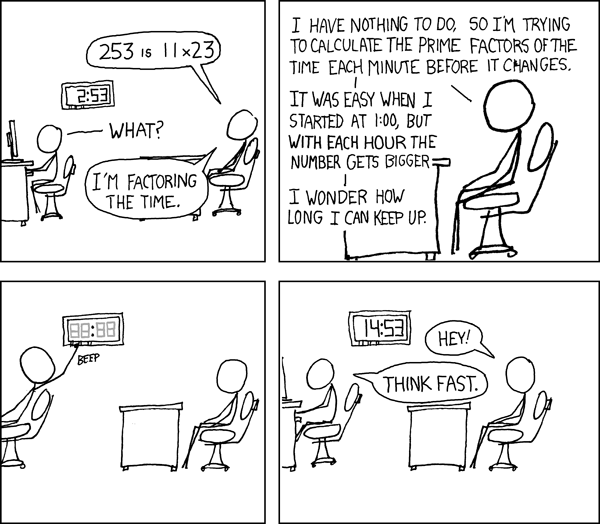
Factoring the time

I stumbled upon this comic that you might enjoy... factoring the time (from xkcd.com).


help with math

Easiest Geometry Test Evar?


How could anyone fail this test?

Your square doesn't have 4 90 degree corners
Your rectangle has four sides of different length
Your circle isn't 'circular' enough
Your oval isn't 'ovular' enough
Your regular trapezoid doesn't have the required parallel lines and matching angles
Your triangle lines overlap each other
Your hexagon isn't 'hexagonal' enough

Try again, and don't worry you can retake this college entrance exam as many times a! s you want.


geometry exam answers

hw: 4/23

hw: ws 11.1

factoring special products calculator

hw: 4/23

hw: ws 11.1

factor by grouping calculator

three anecdotes

1) So we were graphing quadratic equations in class last week, and I had two students, one boy and one girl, who were having a hard time with it. I called them over to my desk to go over the basics. I said, "Okay, so we know that the graph of a quadratic equation is a parabola, right? And if the leading coefficient is positive, the parabola opens up, and if it's negative, the parabola opens down." As I spoke, I drew the following picture:
Then I said, "So, if we want to graph a quadratic equation, the first thing we need to do is find the vertex of the parabola." My female studen! t sais, "What's the vertex?" I said, "The vertex is the lowest point of a parabola that opens up or the highest point of a parabola that opens down," and, as I spoke, I marked the vertices of the two parabolas I had drawn:
My male student immediately started giggling. My female student looked at him and said, "What's so funny?"

God, I love fourteen year old boys.

2) The kid and I were watching the Sox/Yankees game yesterday afternoon (yeah, I know, we lost, but we kick! ed their fucking asses today, so fuck you). Hubby has taug! ht the k id that the Yankees smell bad, so every time a batter came up to the plate, the kid would ask, "Does he smell bad, Mommy?" I found this endlessly delightful. When Derek Jeter came up to bat at one point, the kid asked if he smelled and I said, "Yes, honey. That's Derek Jeter. He smells terrible." She said, "Why does he smell bad?" I said, "Because his soul is dirty." Later, she asked, "What do the Yankees smell like, Mommy?" I replied, "Feet and broken dreams."

3) Then this morning at breakfast, while we were watching the Sunday news shows, the kid looked up at the television (yes, we eat breakfast in front of the television on Sunday mornings - I'm the worst parent ever) and said, "Hey, what's that face?" Hubby replied, "That's Senator Sam! Brownback." The kid asked, "But why's he making that face?" I said, "He can't help it, honey." My kid's a fucking genius.

In unrelated news, I am a narcissistic whore and desperately desire your adulation. Therefore, I would like to request that you follow the two links here or in the sidebar over there and go cast your vote for me for the Hottest Mommy Blogger and Best Blog About Stuff awards in the Blogger's Choice Awards. If I win, I'll totally post some new pictures of my tits.


finding the vertex of a parabola